- Home
- Applications
- Tank Level Monitoring Solutions
Application
Tank Level Monitoring for Water, Fuel and Chemical Tanks
Tank level monitoring keeps storage tanks from running dry or overflowing, supports inventory control and protects downstream pumps. The right instrument depends on whether you need continuous measurement, point alarms or only visual indication, and on the liquid itself: clean water, diesel, chemicals or sludge. Flotronics supplies hydrostatic level transmitters, level switches, gauges and controllers and helps you match them to the tank and the control system. Send your tank and media details and we will suggest suitable options for quotation. We can also advise on combining instruments, for example a transmitter for control with an independent switch for protection, so the installation is easy to commission and maintain.
The challenge
What needs to be solved
A tank looks simple, but the level instrument faces real constraints. Liquids can be corrosive, foamy, viscous or full of solids, and temperature may vary. Tanks may be open, vented or pressurised, deep underground or fitted with agitators that create turbulence. Some measurement principles are affected by density changes, vapour or condensation, while mechanical ones may stick in sludge. A mistake means overflows, dry-running pumps, spills or inaccurate stock figures.
You also need to decide who needs the information: an operator at the tank, a PLC in a control room or a remote monitoring system. Safety-related high-level cut-off usually calls for a separate independent device. Each of these issues is avoidable when the media and operating conditions are fully described at the start.
The approach
Measurement & control options
Match the instrument to the job:
Continuous level
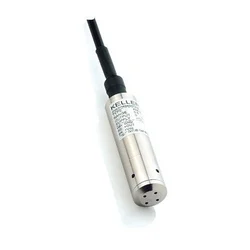
A submersible or insertion hydrostatic level transmitter measures pressure from the liquid column and gives a 4–20 mA signal. It suits water, wastewater, borewells and many fuels, provided the density is known and stable.
Point alarms and pump control
Level switches such as floats or vibrating types give high, low and cut-off signals. Conductive probes with a water level controller automate overhead tanks.
Local indication
Level gauges and level indicators show the level without power and give technicians a check on electronics.
Data logging
Digital water level recorders support well and reservoir monitoring.
For safety duty use an independent high-high switch rather than relying on the same transmitter used for control. Choose wetted materials for the liquid, mounting for the tank type, and an output the PLC accepts. Combine technologies where it helps: transmitter for control, switch for protection, gauge for verification.
Whatever the combination, document set points and test them at commissioning. Periodic proof testing of the high-level and low-level functions confirms that alarms and cut-offs still work, and spare switches or probes kept on site shorten any outage. Where tanks hold hazardous liquids, check the classification of the area before choosing the electrical equipment.
Products
Product types for this application
Product type
Hydrostatic level transmitterContinuous level in water, wastewater, fuel and borewells via 4–20 mA.
View rangeProduct type
Level switch
High, low and cut-off signals for alarms and pump control.

Product type
Float switchSimple point detection in clean water and fuel tanks.
View range
Product type
Water level controllerAutomatic fill and dry-run control for overhead and sump tanks.
View range
Product type
Level gaugeDirect visual indication without power.
View range
Product type
Digital water level recorderLogging of well and reservoir levels over time.
View rangeQuotation checklist
What to send us
- Liquid name, density and temperature
- Tank type: open, vented or pressurised, with dimensions and height
- Measurement range or switching points required
- Output needed: 4–20 mA, relay contact or local indication only
- Wetted material or chemical compatibility requirements
- Mounting type and process connection
- Supply voltage and hazardous-area classification
- Quantity of tanks and any pump control logic
Industries
- Water and wastewater
- Oil and gas storage
- Chemical processing
- Food and beverage
- Power and utilities
FAQ
Frequently asked questions
Answers to the questions buyers most often ask before requesting a quotation.
Do I need a transmitter or a switch for my tank?
Use a transmitter if you need the level continuously for control, stock or trending. A switch is enough for fixed alarm or pump start-stop points. Many tanks use a transmitter plus an independent high-level switch.
Will a hydrostatic transmitter work for any liquid?
It works well when liquid density is stable and the diaphragm material suits the media. Highly viscous, foaming or sludgy liquids or varying density may call for another principle.
Can level control be automated for pumps?
Yes. Level switches or a controller can start and stop the pump between set points and protect against dry running. Tell us the pump power and starter arrangement.
Need help selecting the right product?
Send the product type, operating parameters and quantity. If you are unsure of a value, mark it unknown — we will help you specify it.