Product family
Temperature Instrumentation: Sensors, Thermowells and Indicators
Temperature measurement protects equipment, controls reactions and proves that a process stayed within limits. Flotronics supplies temperature sensors and related instruments for industrial users, and we help you match the sensing element, protection and output to the job.
Application-first selection
Tell us the medium, range and conditions — we match the product type to the duty.
Multi-category sourcing
Instruments, valves, filters, pneumatics and pumps on one enquiry.
Quotation against your specs
Every quote references the parameters you sent, so comparisons are like-for-like.
Engineer-to-engineer support
Ask a technical question before you commit to a model.
Product types
Temperature Instrumentation — categories
The key choices are the sensor principle, the measuring range, the response time you need, how the sensor is protected from the process and how its signal reaches your controller. Share your medium, temperature range and fitting details and we will suggest suitable options and prepare a quotation based on what we can source. Our team can also review an existing datasheet or nameplate and suggest equivalents, so you do not need a full specification to begin. Choose a category to see the range, specifications and quotation details.
Temperature Instrumentation
Temperature Sensors: Thermocouples for High-Temperature ProcessTemperature sensors turn heat into an electrical signal for display, control and alarms. This page covers thermocouples, which generate a…
View rangeHow it works
Types and how to choose
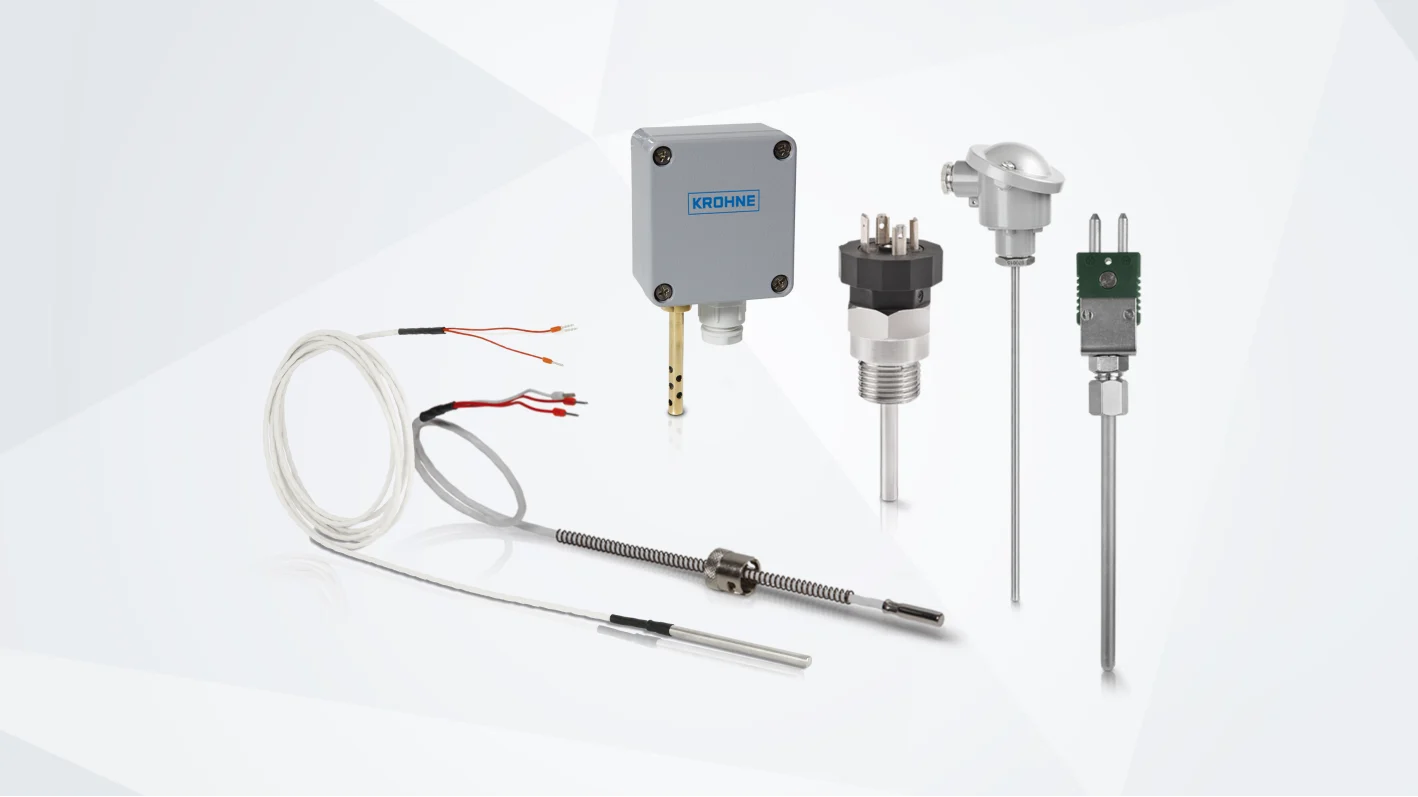
Two sensor families dominate industry. Resistance temperature detectors (RTDs), usually Pt100, change resistance predictably with temperature and give stable, accurate readings over a moderate range. Thermocouples generate a small voltage where two dissimilar metals join, work over a much wider range and respond quickly, but are somewhat less accurate and need correct extension cable and cold-junction compensation. Thermistors are very sensitive over narrow ranges and appear mostly in compact or OEM devices.
Bimetallic and filled-system dial thermometers provide simple local indication without power. For control systems, sensors are paired with a transmitter that converts the signal to 4–20 mA, which improves noise immunity over long cable runs.
In the process, the sensor rarely touches the fluid directly. A thermowell protects it from pressure, flow and corrosion, allowing removal without draining the line, but adds response time. Selection therefore balances range, accuracy, speed, material compatibility and mechanical fit. For a starting point, see our temperature sensors; boiler and steam users may also need boiler equipment.
| Type | Best suited for | Consider when |
|---|---|---|
| RTD (Pt100) | Accurate, stable measurement in general process use | Very high temperatures or fast response are required |
| Thermocouple | Wide ranges, furnaces and fast response | High accuracy and long-term stability matter most |
| Thermistor | Compact devices with a narrow, sensitive range | Wide-range measurement is needed |
| Bimetallic dial thermometer | Local indication without power | A signal for control or logging is needed |
| Temperature transmitter | Converting sensor signals to 4–20 mA | Direct sensor-to-controller wiring is short and acceptable |
| Thermowell | Protecting sensors in pressurised or flowing lines | Response time is critical or process is hygienic |
Selection guide
Parameters to specify
Send these with your enquiry for an accurate, like-for-like quotation.
Typical applications
- Boiler, steam and condensate lines
- Heat exchanger and chiller loops
- Furnaces and ovens
- Reactor and tank temperature monitoring
- Compressor and motor protection
- Cold storage and HVAC
- Food and pharma process lines
Industries
- Chemical and process
- Power and boilers
- Food and beverage
- Pharmaceutical
- HVAC and building services
- Textile and plastics
FAQ
Frequently asked questions
Answers to the questions buyers most often ask before requesting a quotation.
Should I choose an RTD or a thermocouple?
RTDs, typically Pt100, give better accuracy and long-term stability over moderate ranges, so they suit most process monitoring. Thermocouples cover very high temperatures, respond quickly and are rugged, making them common in furnaces and kilns. Tell us the temperature range, accuracy needed and vibration conditions and we can recommend one.
Why is a thermowell used?
A thermowell is a closed tube that holds the sensor in the line. It protects the sensor from pressure, velocity and corrosive media and allows removal or replacement without draining the system. The trade-off is slower response and the need to size the well for flow-induced vibration, so specify the well along with the sensor.
What is the difference between a 2, 3 and 4-wire RTD?
The wire count affects how lead resistance is handled. A 2-wire connection includes lead resistance in the reading, which can cause error. 3-wire compensates for it in most industrial systems and is very common. 4-wire eliminates lead resistance effects and is used for high-accuracy work. Your controller or transmitter input decides which is suitable.
What do you need to quote a temperature sensor?
Please send the measured medium, temperature range, process connection and insertion length, thermowell requirement and material, output type, and any hazardous-area or hygienic requirement. If you are replacing an existing sensor, a photo or its nameplate details speeds things up. Mention the wire configuration your transmitter or controller expects, and how many sensors you need.
Do temperature sensors need calibration?
Yes. Sensors can drift with thermal cycling, contamination and age. How often depends on how critical the measurement is and your quality system. Critical processes are checked against a reference at set intervals; for general monitoring, comparison checks at maintenance shutdowns are common. A comparison against a calibrated reference thermometer is often used for routine checks in plants.
Need a temperature sensor for your process?
Share the medium, temperature range, connection and output required, and we will suggest suitable options and prepare a quote.