Product family
Pneumatics: Cylinders, Fittings, Speed Controllers and Valves
Pneumatic systems use compressed air to move, clamp, position and sort. They are common on packaging lines, assembly machines, material handling and process valve actuation because they are fast, simple and tolerant of harsh conditions.

Application-first selection
Tell us the medium, range and conditions — we match the product type to the duty.
Multi-category sourcing
Instruments, valves, filters, pneumatics and pumps on one enquiry.
Quotation against your specs
Every quote references the parameters you sent, so comparisons are like-for-like.
Engineer-to-engineer support
Ask a technical question before you commit to a model.
Product types
Pneumatics — categories
Flotronics supplies pneumatic cylinders, push-in fittings, speed controllers, high-pressure pneumatic valves and related components for machine builders, maintenance teams and plant engineers. Good performance depends on correct sizing of force and speed, sound air preparation upstream, and compatible connections. Share your application and air supply details and we will help identify suitable components and prepare a quotation. Our team can also review an existing datasheet or nameplate and suggest equivalents, so you do not need a full specification to begin. Choose a category to see the range, specifications and quotation details.
Pneumatics
Pneumatic Micro Cylinders (Pneumax, ISO 6432)Pneumatic micro cylinders convert compressed air into linear motion for small automation tasks such as clamping, pushing and positioning.…
View range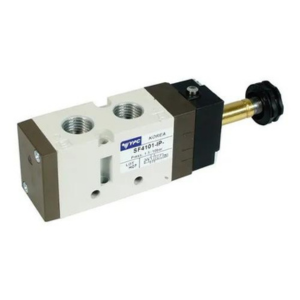
Pneumatics
YPC SF4101-IP Flexible Solenoid Valve (5/2, G1/4")The SF4101-IP is a YPC pneumatic solenoid valve in a 5/2 single-port function with G 1/4 inch ports, used to direct compressed air to…
View range
Pneumatics
Pneumax PU Push-In Fittings for Pneumatic ConnectionsPush-in fittings connect pneumatic tubing to valves, cylinders and manifolds without tools or ferrules, which speeds up installation and…
View rangeHow it works
Types and how to choose
A pneumatic circuit has four parts: an air supply, air preparation, control valves and actuators. Compressed air is cleaned and regulated, a directional valve routes it, and an actuator turns that pressure into force and motion.
The most common actuator is the cylinder. Force depends on bore area and supply pressure, so a larger bore gives more force at the same pressure. Single-acting cylinders use air in one direction and a spring to return; double-acting cylinders use air both ways and give controlled force on extend and retract. Stroke, mounting style, rod end and cushioning at the end of travel complete the choice.
Speed is set with flow control (speed controller) valves. Fitting them to meter exhaust air from the cylinder, called meter-out, usually gives smoother, more stable motion than metering supply air. Reliable operation also depends on push-in fittings and tubing sized to the flow, and on dry, filtered, lubricated or oil-free air as the components require. Upstream treatment is covered under compressed air treatment; see also pneumatic cylinders, push-in fittings and speed controllers.
| Type | Best suited for | Consider when |
|---|---|---|
| Single-acting cylinder | Clamping, ejecting or simple push/return tasks | Force is needed on both strokes |
| Double-acting cylinder | General positioning and pushing/pulling | Spring return failsafe is wanted |
| Push-in fitting | Fast, tool-free tubing connections | Vibration is severe or tubing is not of the specified type |
| Speed controller | Setting cylinder speed smoothly | Fixed speed is acceptable |
| High-pressure pneumatic valve | Higher-pressure air circuits such as blow-moulding | Standard pressure circuit is sufficient |
| Solenoid-operated directional valve | Electrically switching air to actuators | Manual or mechanical operation is enough |
Selection guide
Parameters to specify
Send these with your enquiry for an accurate, like-for-like quotation.
Typical applications
- Packaging and filling machines
- Clamping and fixturing
- Material handling and sorting
- Process valve actuation
- Assembly and pick-and-place
- Door and gate operation
- Bottle blowing and moulding with high-pressure air
Industries
- Packaging
- Automotive and engineering
- Food and beverage
- Plastics and PET
- Textile
- Process plants
FAQ
Frequently asked questions
Answers to the questions buyers most often ask before requesting a quotation.
How do I size a pneumatic cylinder?
Work out the force the load needs, add a margin for friction and acceleration, then pick a bore whose area times your working pressure exceeds it. Remember that force on the retract stroke of a double-acting cylinder is lower because the rod occupies part of the piston area. Send the load, stroke and pressure and we can suggest options.
Should I use meter-in or meter-out speed control?
Meter-out, restricting exhaust air from the cylinder, is generally preferred for double-acting cylinders because it keeps back-pressure on the piston and gives steadier motion. Meter-in suits single-acting cylinders and some lifting cases. The right choice depends on load direction, so tell us the orientation. Using flow controls on both ports gives separate speed settings for each direction where the process needs it.
Are push-in fittings reusable?
Most push-in fittings can be released and reused if the tube end is clean and square-cut and the fitting has not been damaged. Use the tube type and outside diameter the fitting is designed for. Fittings in vibration-prone or high-temperature locations should be checked at maintenance intervals. Check the tube material compatibility and use tube cutters rather than knives to keep the end square and the seal reliable.
Do pneumatic components need lubricated air?
Many modern cylinders and valves are pre-lubricated and run on non-lubricated air, and adding oil later can wash out the factory grease. Others are designed for lubricated supply. Follow the component data and keep the supply consistent. Clean, dry air matters either way; see compressed air treatment. Tell us the supply condition you run and any existing lubricators so compatible components can be proposed.
What do you need to quote pneumatic components?
Share bore and stroke or the load, mounting style, operating pressure, port thread, tube size, voltage for any solenoid valves, and the working environment. If replacing, send the model number or a photo of the existing part. With these details we can suggest matching cylinders, fittings, speed controllers and valves together as one package to reduce mismatches.
Looking for pneumatic cylinders or fittings?
Send the load, stroke, pressure, port and tubing sizes, and we will suggest suitable components and quote.